Gradual opening-wedge high tibial osteotomy (HTO)Freedom from
knee pain.
For bow legs (varus knee)UniPlasty is designed to correct bow-leg alignment. Discover a gradual, adjustable approach to bringing the leg back into alignment.
Explore UniPlastyLife moves. Move with it.

Bow legs. A question of alignment.
With bow legs (bowlegged knees, sometimes called O-legs), also known as varus knee or genu varum, the knees remain apart when the ankles come together. This alignment can place more load on the inner side of the knee and, over time, contribute to wear of the cartilage there (medial knee osteoarthritis).
UniPlasty is used for high tibial osteotomy (HTO): the upper shinbone is realigned through controlled, gradual bone correction. An orthopedic specialist assesses whether this approach is suitable for your knee.
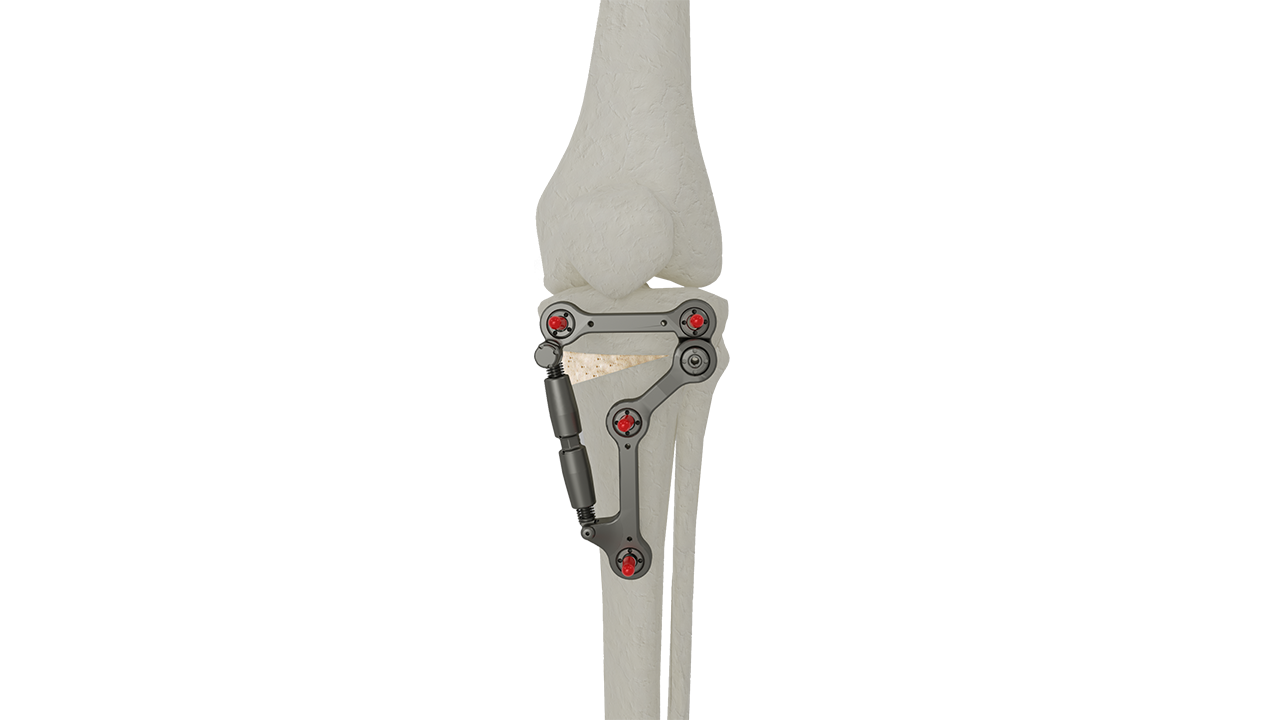
In a conventional HTO, the angle is corrected in a single step during surgery, either by opening a wedge on the inner side of the shinbone (opening-wedge HTO) or by removing a small wedge of bone from the outer side (closing-wedge HTO), and then held with a plate and screws. UniPlasty is a gradual opening-wedge HTO: the wedge on the inner side is opened step by step after surgery with a temporary external fixator and can be fine-tuned along the way.
Explore the correction approachA different perspective on knee alignment.
Precise. Adjustable. No internal plate or screws: a temporary external fixator is used during healing and then removed.
Designed by Prof. Rainer Baumgart
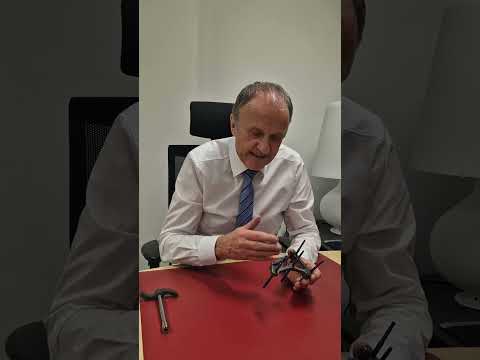
Prof. Rainer Baumgart introduces UniPlasty.
UniPlasty corrects alignment through controlled, gradual elevation of the bone, with the aim of bringing the leg into line with its natural biomechanics. Its adjustable hinge system lets the surgeon fine-tune the angle during correction — the principle behind “Jack it up”.
Manufactured by Response Ortho, a designer and manufacturer of advanced technologies for deformity correction.
The device used in the UniPlasty technique is FDA-cleared and CE-marked.
Why UniPlasty?
Preserve your own knee with a gradual approach to alignment. Here is what the treatment is designed to offer.
- Small incisions. Less surgical disruption.
- A minimally invasive approach designed to limit incision size and scarring. Scars still occur, and healing differs from person to person.
- No second open operation to remove an internal plate.
- UniPlasty does not use an internal plate. After bone healing, the external fixator is taken off and only its four pins are removed, in a simple procedure.
- Nothing left under the skin.
- UniPlasty works without internal plates or screws. Once the temporary external fixator and its pins are removed, no implant remains in your body.
- Precise alignment. Supported steps early in recovery.
- Gradual adjustment allows the team to refine alignment while planning a supported return to walking. Your surgeon sets when and how much weight you can put on the leg.
Planned around you. Adjusted with care.
Understanding your options begins with understanding the approach. Your clinical team determines whether alignment correction is suitable for you.
Why check alignment while standing?
The way your leg carries weight matters. During follow-up, your team uses weight-bearing X-rays to assess alignment and guide gradual adjustments. New bone forms at the osteotomy site and strengthens before the device is removed.
UniPlasty uses the UniX Metaphyseal Hinge Fixator, featuring a patented design for precise, gradual alignment correction.
Understand the alignment
Start with an individual assessment and discuss your concerns with your specialist. With preoperative planning support, it is possible to simulate what the corrected bone will look like.
Explore the approach
Learn how the adjustable system is used as part of a planned correction.
Discuss what comes next
Ask about the procedure, follow-up and what recovery could mean for your daily life.
See how gradual correction works.
The animation shows the osteotomy, temporary fixation and adjustable hinge used to gradually elevate the bone and fine-tune alignment. Precise planning. Gradual correction. Natural healing.
Is UniPlasty right for you?
UniPlasty is designed for knee malalignment, particularly bow legs (varus knee), when preserving the natural joint is the treatment goal. An orthopaedic assessment determines whether it is suitable for you.
- Precise, controlled correction of bow legs.
- Preserving your own knee without internal plates or screws, so no later operation is needed to remove internal hardware.
- A less invasive approach, with smaller scars and faster recovery as treatment goals.
- Returning to daily activities and an active lifestyle.
These are treatment goals, not promised outcomes. UniPlasty still involves an osteotomy and temporary external fixation. The surgeon plans correction, wound care and device removal with you; since no internal plate or screws are used, removal means taking off the fixator and its four pins in a simple procedure. After healing, the aim is stable, naturally aligned bone of your own.
Alignment changes how your knee carries you.
Varus alignment can concentrate load on the inner knee, contribute to progressive cartilage damage and early osteoarthritis of the inner knee, and affect gait and posture. Restoring the mechanical axis aims to distribute load more evenly, protect native cartilage and improve balance, mobility and function—particularly important for younger, active patients.

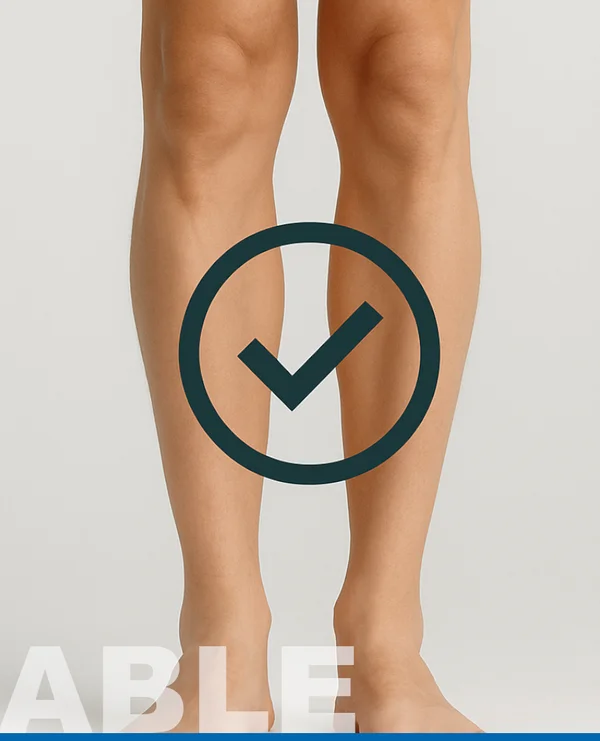
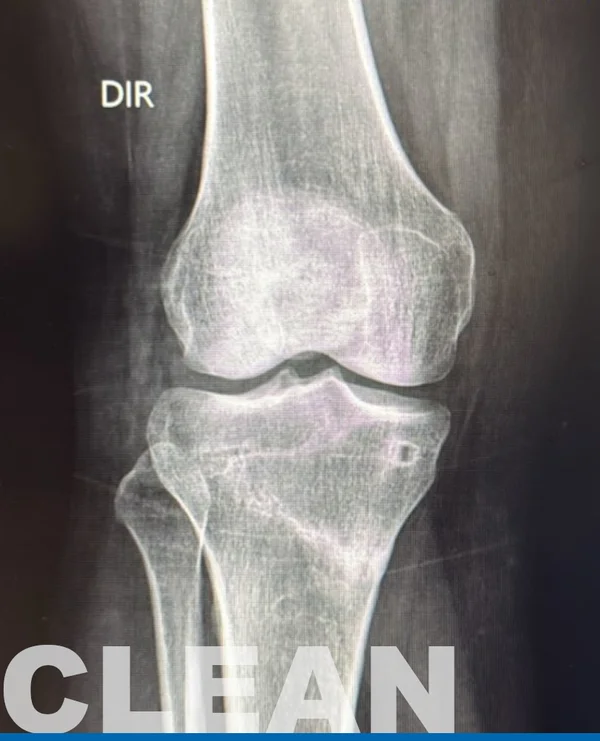
Original educational illustrations; not a prediction of individual results.
Your treatment, step by step.
Bone consolidation takes approximately 2–3 months. The total time wearing the external fixator—from surgery day to removal day—is approximately 3–4 months. Your surgeon confirms the timing based on your individual healing.
- Day 0
Planning & surgery
Assessment and individual alignment planning are followed by surgery and application of the correction system.
- 5–7 days
Waiting period
A short period after surgery before gradual correction begins.
- 7–14 days
Gradual correction
The daily correction is 0.66°: 0.33° in the morning and 0.33° at night, following your treating team’s individual plan.
- 2–3 months
Bone consolidation
New bone regenerates and strengthens while the corrected alignment is maintained.
3–4monthsFrom surgery to device removal
Device removal
Once X-rays confirm sufficient bone healing, the team plans removal of the temporary fixator and pins. This can usually be a smaller outpatient procedure; your surgeon explains the setting, pain relief and follow-up.
Movement during recovery
The original guide describes supported walking during the first month and a gradual return to daily activities early in recovery. Weight bearing, exercises and return to work or sport must follow your treating team’s instructions.
Caring for the temporary pins
The external fixator connects to the bone through temporary pins. Pin sites need care and can become infected. Follow your treating team’s cleaning and monitoring instructions, and contact them if a pin site becomes more painful, red or starts to discharge.
A compact device for daily life.
The UniX fixator has a low profile of 9 mm. Loose-fitting clothing can help accommodate the device during treatment. Comfort and mobility vary; your team helps you plan clothing, walking aids and everyday activities.
Recovery in motion.
Watch the original postoperative examples at three points in recovery. These are individual examples, not a timetable or result guaranteed for every patient.
2 weeks after surgery
Seated knee movement during early rehabilitation.
5 weeks after surgery
Exercise on a stationary bicycle during recovery.
8 weeks after surgery
A step exercise during later rehabilitation.
Courtesy of Diego Faria
Preserving the knee: what does the evidence say?
UniPlasty is also a device for HTO (high tibial osteotomy) treatment. A study on HTO treatment (22 patients, 31 knees) reported 87.1% without knee replacement at 10 years. This is general osteotomy evidence, not a UniPlasty-specific success rate.
The aim of realignment is to preserve the native joint and potentially delay replacement. Individual suitability and outcomes differ.
Read the studyLau et al. · Journal of Orthopaedic Translation, 26 (2021), 60–66 · DOI: 10.1016/j.jot.2020.03.003
Learn more about bow legs and HTO
Detailed answers to the questions patients ask most often.
- Bow legs (varus knee): causes, symptoms and treatmentWhat bow legs are, why they can overload the inner knee and how they are treated.
- Who is HTO for?The patient groups that may benefit from a knee-preserving HTO, and when other options fit better.
- Opening wedge, closing wedge and gradual opening wedgeOpening-wedge, closing-wedge and gradual opening-wedge HTO compared in one table.
- HTO or knee replacement?How HTO and knee replacement differ, and who each is usually considered for.
- Recovery after HTO with UniPlastyA typical recovery timeline: walking, correction, weight bearing, work, exercise and removal.
Good questions. A clearer next step.
Your journeyWhat is a high tibial osteotomy (HTO)?
A high tibial osteotomy (HTO) is a knee-preserving operation for bow legs. The surgeon operates on the upper shinbone (tibia) to change its angle in a controlled way, so that the load line of the leg moves away from the overloaded inner side of the knee. Your own knee joint is kept.
Opening wedge, closing wedge or gradual correction: what is the difference?
In an opening-wedge HTO (OWHTO), the bone is opened on the inner side of the tibia; in a closing-wedge HTO (CWHTO), a small wedge of bone is removed from the outer side. In both, the correction is usually completed in a single step during surgery and held with a plate and screws. UniPlasty is a gradual opening-wedge HTO: the wedge on the inner side is opened step by step over the following days with a temporary external fixator and can be adjusted to follow-up X-rays. Which technique suits you depends on your individual assessment.
Is HTO an alternative to knee replacement?
For some patients, yes. HTO aims to preserve the natural knee by correcting its alignment and is usually considered when the wear is limited to the inner side of the knee. When the whole joint is damaged, a partial or total knee replacement may be more suitable. Only an orthopaedic assessment can tell which option fits your situation.
How does UniPlasty correct alignment?
An adjustable hinge system enables controlled, gradual elevation of the bone. The surgeon can fine-tune the angle during correction to realign the leg according to the treatment plan. Because the correction happens after surgery, the alignment can be checked and adjusted under weight-bearing conditions, while you stand on the leg, which is very important to see the best result.
Will a plate or screws be left in my body?
No. UniPlasty does not work with an internal plate or screws, so nothing is left under the skin after treatment. During correction and healing, the external fixator is attached to the bone by four pins; once your surgeon confirms sufficient healing, the fixator is taken off and the pins are removed in a simple procedure.
Is UniPlasty right for me?
An orthopedic specialist needs to assess your individual situation. This website cannot determine your suitability for treatment.
How long does treatment take?
The original UniPlasty treatment guide describes approximately 3–4 months overall. Age, the degree of deformity and bone healing affect the schedule. Your surgeon sets your individual plan.
Where can I learn more?
Explore the answers above, or contact the Response Ortho team directly about UniPlasty. Treatment suitability requires an orthopaedic consultation.
What should I ask my specialist?
Discuss the potential benefits, risks, alternatives, daily activities during treatment and follow-up requirements.
How large are the incisions, and will I have scars?
The minimally invasive technique aims to use small incisions and limit tissue disruption: small incisions for the four 6 mm pins and, in general, an incision of around 2–3 cm for the osteotomy. Both the surgery and the pin sites can leave scars. Their appearance depends on the procedure, your skin and wound healing.
Will I need another operation to remove the device?
No large second operation is needed. UniPlasty does not work with an internal plate: no plate or screws are buried under the skin that would have to be taken out in a second, larger operation, as with the plate-and-screw technique. After the bone has healed, the external fixator is taken off and only its four pins need to be removed, which is a simple procedure. Your surgeon explains the anaesthesia or pain relief and where it will take place.
When can I put weight on my leg?
Supported walking can begin immediately after surgery, often as early as the next day. Most patients start putting weight on the leg shortly after the correction period, at around 3–4 weeks. Your surgeon sets how much weight you may bear and whether you need crutches, according to your correction and bone healing.
Can I wear normal clothes with the fixator?
Loose-fitting trousers or other roomy clothing can accommodate the low-profile device. Choose clothing that does not rub or press on the pin sites, and discuss comfort and daily activities with your team.
What care do the pin sites need?
Your team will show you how to care for the skin around the temporary pins. Infection can occur. Follow the cleaning instructions and contact your team about increasing pain, redness or discharge.
Can it treat knock knees or both legs?
The device can also be used for selected valgus deformities, often called knock knees. Whether one or both legs should be treated, and in what sequence, depends on an individual orthopaedic assessment.
Your questions belong here.
Explore the answers above, or contact the Response Ortho team directly about UniPlasty. Treatment suitability requires an orthopaedic consultation.
Boynton Beach, FL 33426
United StatesResponse Ortho Teknolojik Üretim A.Ş.İTOSB, 10. Cadde, No: 1
Tuzla, İstanbul, 34959
Türkiyeresponseortho.com